
I Can't Stop Thinking About Forbidden Notebook
 Written by Naznien Malano on
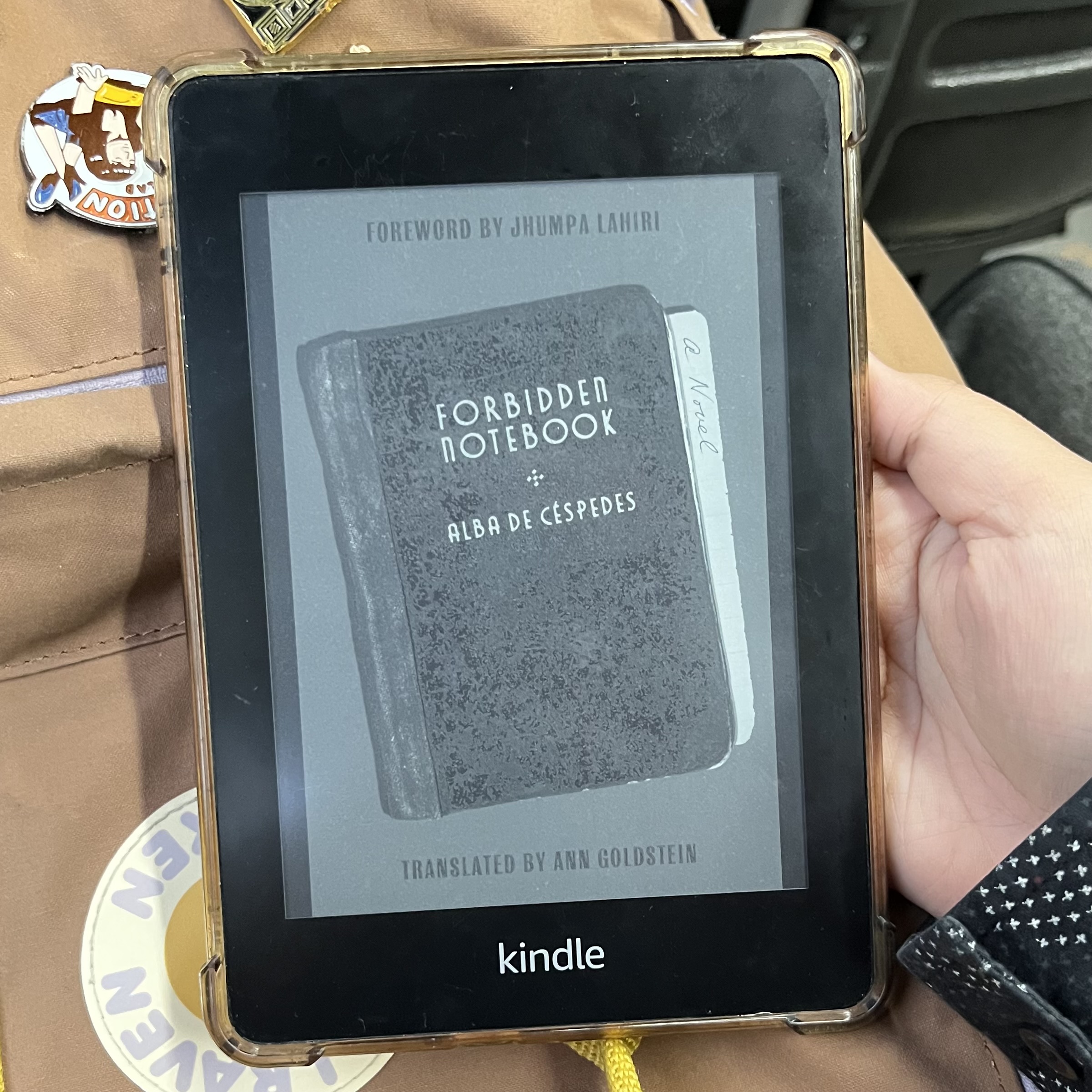
I finished reading Forbidden Notebook by Alba de Céspedes a few days ago, and I haven’t been able to stop thinking about Valeria Cossati ever since. I have read plenty of books about unhappy marriages, complicated families, and women struggling with the expectations placed upon them, but there is something particularly unsettling about this one. Perhaps it is because Valeria’s life is so ordinary, or because the things that trouble her are so familiar that they hardly seem worth mentioning at first. She is a middle-aged woman living in postwar Rome, married with two grown children, working a job while also taking care of her household. Her life is not especially miserable, at least not in any obvious way. She has a family, a home, and a routine that she has followed for years. Then one Sunday morning, she buys a notebook, and somehow that small decision begins to unravel everything she thought she knew about herself.
What fascinates me about this novel is that nothing particularly extraordinary needs to happen for Valeria to start questioning her entire existence. She doesn’t suddenly discover that her marriage is a lie, nor does she experience some dramatic event that forces her to reconsider her life. Instead, she only starts writing. She records conversations, frustrations, observations about her family, and feelings that she has probably experienced before but never bothered to think about it too much. At first, these thoughts seem insignificant, but the more she writes, the more difficult it becomes for her to ignore them. I think there is something almost frightening about the idea that a person can spend decades living a certain way, only to discover that when they start paying attention to their own thoughts, that life feels somehow not right.
One thing that struck me almost immediately was how little space Valeria (and also all mother around the world) has for herself. She works outside the home, contributes financially to the household, and still carries much of the responsibility for keeping the family together. Her husband and children have their own concerns, ambitions, and private lives, but Valeria seems to exist primarily in relation to them. Even the act of writing requires secrecy. She has to hide the notebook and find moments when nobody is around, as though spending time alone with her thoughts is something she should feel ashamed of. I found myself getting increasingly frustrated with how ordinary everyone around her seems to consider this arrangement. Nobody has to explicitly forbid Valeria from having a private life because she has already learned to treat her own needs as secondary.
And yet, I don’t think Valeria is simply a woman who has been denied freedom by the people around her. What makes her interesting, and occasionally infuriating, is how deeply she has internalized the very expectations that make her unhappy. She takes pride in being a devoted wife and mother, even as she begins to resent what those roles have demanded of her. She wants her family to appreciate her sacrifices, but she also seems to believe that making those sacrifices is what gives her life meaning. There are moments when she recognizes how unfair her circumstances are, only to defend them a few pages later. 🙂 I found myself disagreeing with her constantly, sometimes within the same diary entry, but I also think those contradictions are what make her feel like a real person rather than a character written merely to illustrate the injustices of her time.
Her relationship with Mirella was probably one of the most interesting parts of the book for me. Mirella belongs to a younger generation of women who are beginning to question the conventions that Valeria has spent her entire life accepting. She wants to make her own decisions, particularly when it comes to marriage, work, and the kind of future she imagines for herself. Valeria, despite privately feeling dissatisfied with her own life, often responds to her daughter’s independence with suspicion and disapproval. I kept wondering why she couldn’t recognize that Mirella was trying to avoid precisely the kind of life that had left her feeling so unfulfilled. But the more I thought about it, the more complicated their relationship became. Perhaps accepting Mirella’s choices would also mean accepting that some of Valeria’s own sacrifices might not have been as inevitable as she had always believed.
I think there must be something deeply uncomfortable about watching your daughter reject the values around which you have built your entire identity. Valeria has spent years believing that being a good woman means putting her family first, maintaining a respectable marriage, and accepting certain limitations without complaint. Mirella challenges those assumptions simply by refusing to organize her life around them. What looks like independence to Mirella can look like selfishness to Valeria, partly because Valeria has been taught to regard her own desires in much the same way. I don’t think her treatment of Mirella is always fair, and there were plenty of moments when I wished she would just listen to her daughter instead of judging her. Still, I found it difficult to dismiss her reactions as mere hypocrisy. There is a difference between recognizing that your life has been limited and being emotionally prepared to accept that another woman might choose differently.
I also kept thinking about the way Valeria’s family calls her Mamma, as though motherhood has become her entire identity. Of course, there is nothing inherently wrong with being called Mamma by your children, but in Valeria’s case, it seems to reflect something much larger. She has spent so many years being a mother and a wife that she has almost forgotten what it means to be Valeria. The notebook becomes one of the few places where she can exist outside those relationships. She can be dissatisfied with her husband without having to resolve the disagreement, disappointed in her children without immediately feeling obligated to forgive them, or simply uncertain about what she wants. I think the freedom to have thoughts that are not particularly generous or admirable is an underrated part of having a private life. Valeria doesn’t always have to be the patient, understanding woman everyone expects her to be, at least not on paper.
Then there is Guido, whose presence complicates everything even further. I found myself wondering whether Valeria was actually in love with him, or whether she was more attracted to the possibility of becoming a different person in his presence. I don’t mean that her feelings were necessarily insincere. I think she genuinely experienced something with him that had been missing from her marriage for a long time. But I also think Guido represented a version of herself that she had almost forgotten existed. With him, she could be desired, listened to, and regarded as a woman rather than simply someone’s wife or mother. He offered her the possibility of being seen outside the roles that had defined her for so long, and I can understand why that would have been difficult to resist.
What I found particularly sad about her relationship with Guido was that even this possibility of happiness seemed to come with an enormous amount of guilt. Valeria couldn’t simply enjoy being wanted by someone. Every feeling had to be weighed against her responsibilities, her marriage, her children, and the kind of woman she believed herself to be. I kept waiting for her to make a decision, although I wasn’t entirely sure what decision I wanted her to make. I didn’t necessarily want her to leave her husband for Guido, because I wasn’t convinced that a relationship with another man would solve the deeper problem. What I wanted was for her to have the freedom to consider her own happiness without immediately treating it as a betrayal of everyone around her. But perhaps that was asking too much of someone who had spent most of her life believing that her worth depended on how much she was willing to give up.
The more I read, the more I realized that the novel wasn’t really about whether Valeria would eventually leave her marriage or pursue a relationship with Guido. Those possibilities matter, of course, but the more important change is happening in the way she understands herself. Before she starts writing, she seems to have accepted her life as something relatively fixed. She has responsibilities, a family to care for, and a particular role to fulfill. The notebook interrupts that certainty. It allows her to recognize feelings she previously dismissed and to question decisions she had never considered questioning before. Yet the strange thing is that this new awareness doesn’t necessarily make her happier. In fact, it often seems to make her more miserable, because she can no longer ignore the distance between the life she has and the life she might have wanted.
I have always thought of journaling as something that helps people understand themselves, and I suppose that is exactly what happens to Valeria. But Forbidden Notebook made me think about how uncomfortable that process can be. We tend to assume that self-awareness is inherently liberating, that once we understand what makes us unhappy, we can begin making changes. Valeria’s experience suggests something much less reassuring. Sometimes understanding yourself means becoming conscious of problems that you have no idea how to solve. Sometimes it means realizing that the choices you made years ago have consequences you cannot easily undo. I think this is so difficult for Valeria, because questioning her life also means questioning the beliefs that have allowed her to feel proud of it.
This is why I found the ending so upsetting. Throughout the novel, I kept hoping that the notebook would become the beginning of something new for Valeria. Not necessarily a dramatic transformation, but at least a small change in the way she lived. I wanted her to continue writing, to protect that private space she had created for herself, and perhaps eventually to become more comfortable acknowledging what she wanted. Instead, she decides to destroy the notebook. After everything she has written, all the doubts she has confronted and all the things she has finally admitted to herself, she chooses to get rid of the one place where those thoughts have been allowed to exist.
I was frustrated with her at first. It seemed almost unbearable that she would voluntarily surrender something that had become so important to her. But after sitting with the ending for a while, I began to think that destroying the notebook was not necessarily a sign that nothing had changed. Valeria knows more about herself than she did when she first bought it, and I don’t think that knowledge can simply disappear along with the pages. What troubles me is that she has come to regard the notebook, and perhaps the self-awareness it has given her, as something she cannot continue to accommodate within her ordinary life. She has discovered a part of herself that demands attention, but she cannot find a way to make room for it. So she chooses to silence it instead.
There is something particularly tragic about the fact that Valeria’s rebellion is so small. She doesn’t demand a different life or openly reject the expectations placed upon her. She buys a notebook, writes in secret, and allows herself to think things she would never say aloud. Yet even that becomes difficult to sustain. I kept returning to the title, Forbidden Notebook, and thinking about how absurd it is that something as ordinary as keeping a diary could become an act of defiance. The notebook is forbidden not simply because of the circumstances in which she buys it, but because of what it allows her to do. For a few moments each day, she can stop being the person everyone needs her to be and exist as someone with thoughts and desires of her own.
What makes the novel especially effective, I think, is that Alba de Céspedes never makes Valeria particularly easy to admire. She can be unfair to her daughter, resentful toward her family, and unwilling to confront the consequences of her own decisions. Sometimes she seems to understand exactly what is wrong with her life, and then immediately retreats into the same beliefs that have made her unhappy. I don’t think we’re supposed to agree with everything she thinks or does. If anything, the novel becomes more interesting when we don’t. Valeria is both constrained by the expectations of her society and complicit in passing those expectations on to the next generation. She is capable of recognizing injustice without always being willing to challenge it. And she can desperately want something different while remaining terrified of what a different life might require.
I also think there’s something worth considering about the fact that Valeria’s story takes place in a period when women’s roles were changing. She works outside the home, her daughter imagines a future that looks different from her mother’s, and the traditional expectations surrounding marriage and family are beginning to be questioned. Valeria exists somewhere between these possibilities. She has experienced enough change to recognize that another way of living might be possible, but she remains deeply attached to the values with which she was raised. That tension makes her story feel much more complicated than a straightforward account of a woman trapped in an unhappy marriage. She is living through a moment when the definition of what a woman can be is changing, and she doesn’t quite know where she belongs within it.
Perhaps that’s why I haven’t been able to stop thinking about her. I finished the novel wanting to believe that Valeria would eventually find some way to live differently, even though the book gives me little reason to be confident about that. I wonder whether she would miss writing, whether she would eventually buy another notebook, or whether she would simply return to her routine and try not to think too much about everything she had discovered. I wonder what would happen to her relationship with Mirella as her daughter grew older, and whether she might eventually come to understand the choices she had once criticized. Most of all, I wonder whether she would ever find a way to think of herself as Valeria again, rather than only as the person her family expected her to be.
I don’t know if I would have liked Valeria very much had I met her in real life. I probably would have found her judgmental, frustrating, and unnecessarily concerned with what other people thought. But I think I would have felt sorry for her, too. Not because she was incapable of making decisions, but because she had spent so long learning to distrust her own desires that even recognizing them felt like doing something wrong. It’s difficult to imagine what it must be like to reach middle age and realize that you’ve never really allowed yourself to ask what kind of life you wanted.
And I think that’s ultimately what I find so heartbreaking about Forbidden Notebook. Valeria spends the novel slowly learning how to listen to herself, only to decide that she can no longer afford to keep doing it. I wish she had been less afraid of her own thoughts. I wish she had been kinder to Mirella, more willing to question the sacrifices she had made, and less convinced that wanting something for herself made her a bad person. But perhaps wishing she had behaved differently is part of what makes her story so difficult to forget. I can see possibilities for her that she cannot quite bring herself to embrace, and I have no way of knowing whether she ever will.
I keep thinking about that notebook, about all the things Valeria wrote down because she couldn’t say them anywhere else, and about how easily those pages could disappear without anyone around her understanding what they had meant.
I really wish she had kept writing.
Naznien Malano
Hello. My name is Naznien Fevrianne Malano. I'm an Information Systems graduate and currently working as a Data Scientist. In this blog, I'll write about my work, my learnings, the books I read, the movies I watch, and bunch of random things that interesting to write. I'm happy to receive any criticism and suggestions regarding this blog via contact section.
Comments